Knowledge Base

E-waste Recycling Process
The recycling process described here is provided by WEEECycling within the scope of the EECONE project.
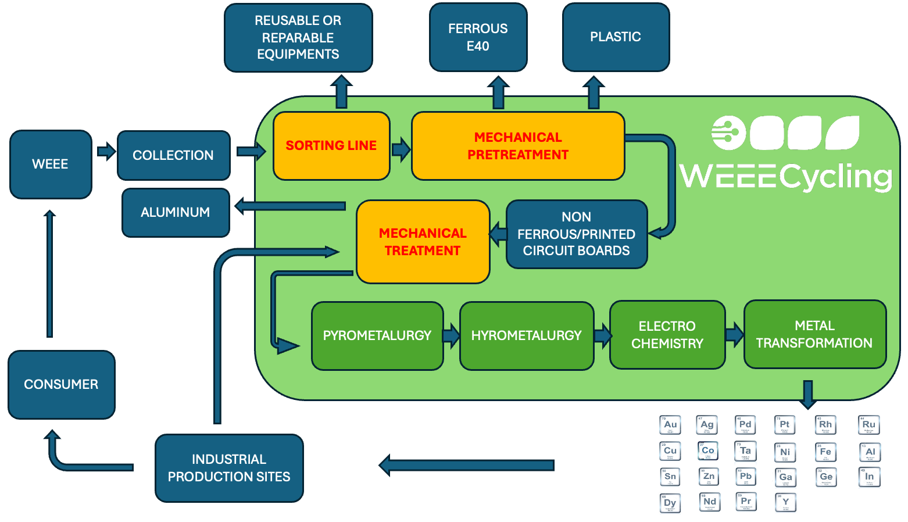
- First, e-waste is collected and sent to the recyler (WEEECycling)
- Then, elements that could be reused or repaired are separated from the waste stream
- A mechanical pretreatment will allow to separated Ferrous element from the stream. Such preatreaments can consist of: the below step:
- Coarse shreeding
- Screening to separate too small pieces from the stream
- Overband to separate large ferrous parts
- Manual sorting to isolate large elements from the streams (plastics, cables,...)
- Finer shredding
- Screening to separate size fractions
- Sorting of ferrous elements using magnets
- Sorting of Aluminium and Copper elements using eddy current
- Plastic separation (e.g. density separation)
- Dust aspiration
- Then, metals can be recovered through:
-
Pyrometallurgy :
Uses high heat to recover metals. The mechanically sorted material (metal-rich concentrates, PCB fragments) is fed into a smelter or furnace. Metals melt and separate by density — copper and precious metals sink into a metal phase, while oxides and silicates float as slag. The resulting copper bullion contains gold, silver, palladium and other metals which are then refined further. Produces a lot of energy demand and off-gases (SO₂, dioxins) requiring treatment.
-
Hydrometallurgy :
Uses aqueous chemistry to selectively dissolve and recover metals. The material is leached in acid (sulfuric, nitric, hydrochloric) or cyanide solutions to bring target metals into solution. Metals are then recovered from the solution by precipitation, solvent extraction, or ion exchange. More selective than pyro — can target specific metals like gold or copper — but generates large volumes of contaminated wastewater requiring treatment.
-
Electrochemistry:
Uses electrical current to refine and deposit metals. The main application is copper electrorefining — impure copper anodes are dissolved and pure copper is plated onto cathodes in a sulfuric acid bath. Precious metals (Au, Ag, Pd) don't dissolve and accumulate as anode slimes which are processed separately. Produces very high purity copper (>99.99%). Also used in electrowinning to recover metals directly from leach solutions. -
Final metal transformation:
A broader term covering the final conversion of recovered metals into sellable products. Essentially the step that turns a refined metal into a standardised commodity that can re-enter the supply chain as a raw material for manufacturing.